The Domain Name System is established
To solve growing scalability issues on the early internet, Paul Mockapetris introduces the Domain Name System (DNS) in RFC 882 and RFC 883, offering a hierarchical, distributed naming system to enable easier, faster and automated resolution of domain names to IP addresses.
The DNS simplified internet use providing a way to map human-readable domain names (for websites, email addresses and more) to computer-readable numbers (IP addresses).
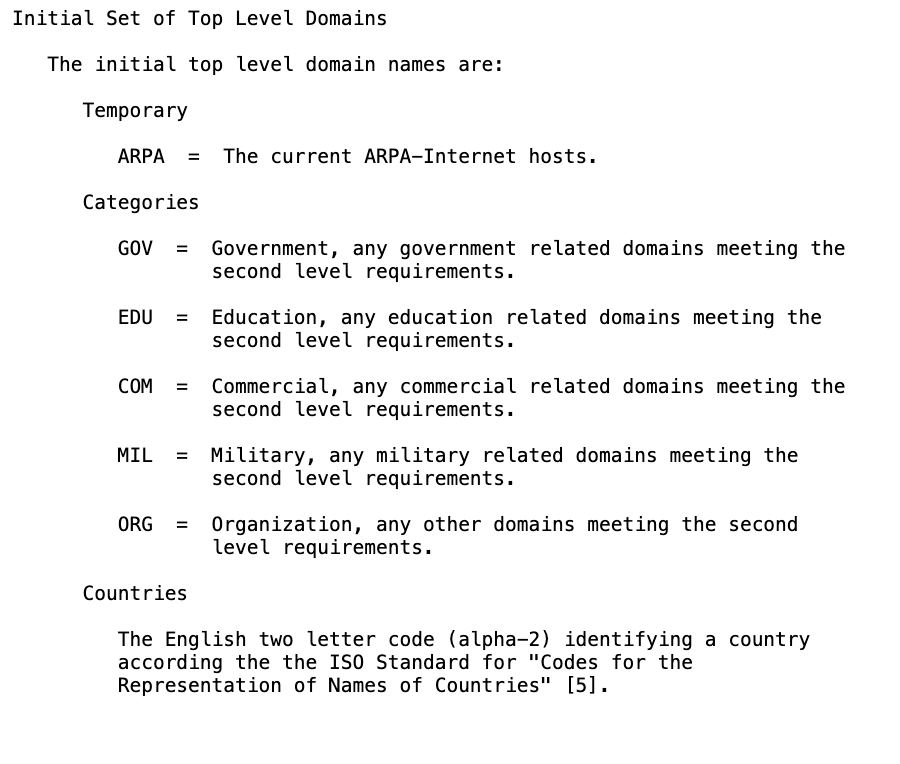
Initial round of TLDs is introduced
Originally proposed in RFC 920 by Jon Postel and Joyce Reynolds, a set of top-level domains (TLDs) are introduced: .com, .net, .org, .edu, .gov and .mil. These initial TLDs are later collectively referred to as Generic Top-Level Domains or gTLDs.
Originally intended for specific uses, with .com designated for commercial entities and .net for network infrastructure, eventually these TLDs became unrestricted – not requiring proof of eligibility or affiliation to register. Some are still sponsored or have registration requirements, such as .edu, which is primarily for colleges and universities.
Oldest active domain name created
Nordu.net is established for NORDUnet, a Nordic research network.
First ccTLDs delegated
The first country code top-level domains (ccTLDs) are formally delegated, beginning with .us (United States) on Feb. 15, followed by .uk (United Kingdom) on July 24, and .il (Israel) on Oct. 24. Leveraging two-character country codes, these delegations mark the initial implementation of geographically designated namespaces within the DNS.
First .com domain name registered
Symbolics.com is registered by Symbolics Computer Corporation, a computer systems company in Cambridge, Mass., becoming the first domain name recorded in the .com DNS.
Initial .edu domain names are registered
The Carnegie Mellon University, Purdue University, Rice University, University of California, Berkeley and University of California, Los Angeles share the top spot for first educational institutions to register a .edu domain name.
1,000 domain names registered in the domain space
The first domain name registrar
The National Science Foundation granted an exclusive contract to Network Solutions to be the first domain name registrar, granting it exclusive authority to manage registrations for the .com, .net and .org top-level domains.
Domain name registrations opened to consumers
Network Solutions begins charging $100 for two-year domain name registrations. Previously, domain names were free.
GoDaddy founded, simplifying domain registration
GoDaddy enters the market as a domain name registrar, offering affordable and user-friendly domain name registration services. By targeting small businesses and individual users with simplified tools and competitive pricing, GoDaddy rapidly became a leading retail registrar.
782,000 domain names registered worldwide
20 million domain names registered in the domain name space
Truth in Domain Names Act targets online abuse
As part of the PROTECT Act passed in the United States, the Truth in Domain Names Act makes it a criminal offense to register misleading domains intended to deceive users into accessing obscene or harmful content. The change marks one of the earliest legislative actions against domain name abuse.
85 million domain names registered in the domain space
205 million domain names registered in the domain space
DNS namespace expands with open applications for new gTLDs
ICANN opens the application process for organizations to operate new generic top-level domains (gTLDs), including brand-specific, industry and geographic extensions.
The program leads to the delegation of thousands of new gTLDs, initiating one of the most significant expansions of the domain name ecosystem.
Pandemic and reliance on online services drive demand for domains
Lockdowns and remote work mandates accelerate digital transformation globally at the outset of the COVID-19 pandemic. Small businesses, schools, and services providers around the world rapidly moved online, driving a surge in new domain registrations and increasing reliance on DNS infrastructure for stability and availability.