ARPANET is formed
Larry Roberts, director of the U.S. Advanced Research Projects Agency (ARPA, later DARPA, the Defense Advanced Research Projects Agency), publishes a plan for a computer network system called ARPANET. Weeks later, the project is approved, laying the foundation for the modern internet and, eventually, the DNS.
Interface Message Processors (IMPs, now called routers) are installed in computers at UCLA and Stanford. UCLA students would “login” to Stanford's computer, access its databases and try to send data to Stanford. At UCLA Vint Cerf, Steve Crocker and Jon Postel work with Leonard Kleinrock, pioneering packet switching technology.
First contact
UCLA and Stanford Research Institute (SRI) establish the first successful host-to-host ARPANET connection using Interface Message Processors (IMPs), sending the first message over what would become the internet.
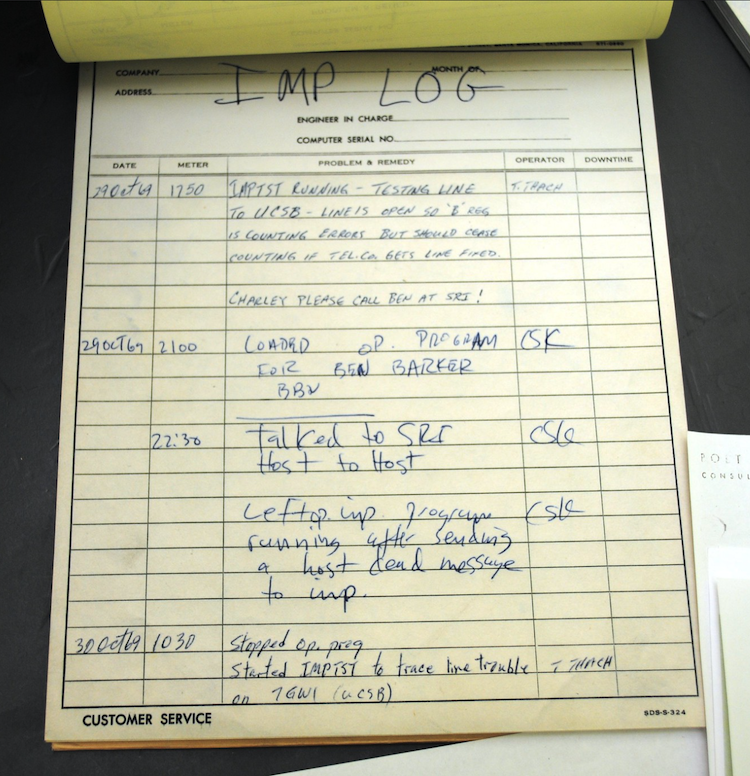
At 10:30 p.m. on Oct. 29, 1969, the first successful message sent over the nascent network was an attempt to “login” to a host at SRI from a host located at UCLA. The only record of this event is a hand-written entry in an IMP logbook. The letters L and O were transmitted but the computer crashed before receiving the letter G.
IP addresses introduced, TCP/IP protocols developed
The Transmission Control Protocol/Internet Protocol (TCP/IP) is developed by Vint Cerf and Robert Kahn and formally documented in RFC 675. This suite of communication rules and procedures still governs how devices connect, find each other and exchange data over networks.
Internet Protocol, or IP addresses are unique identifiers for devices on a network, allowing computers to find and communicate with each other, wherever they are in the world.
The layers of TCP/IP protocols enable internet-connected to correctly transmit, route and receive data.
Public key cryptography made practical
Ron Rivest, Adi Shamir and Leonard Adleman publish the RSA algorithm, offering the first practical implementation of public key cryptography.
RSA-based cryptography uses the combination of a user’s private key (a secret pair of randomly chosen prime numbers) and their public key (the product of those prime numbers) to sign, encrypt and decrypt messages. The mathematical complexity of factoring the product of two large prime numbers, known as the “factoring problem,” means the RSA algorithm is ideally suited for data confidentiality and security.
The need for a namespace
With RFC 799, David Mills proposes a hierarchical namespace to organize the increasing number of IP addresses at scale. This foundational idea was an important catalyst for the development of the DNS.
“In the long run, it will not be practicable for every internet host to include all internet hosts in its name-address tables. Even now, with over four hundred names and nicknames in the combined ARPANET-DCNET tables, this has become awkward.”
The Domain Name System is established
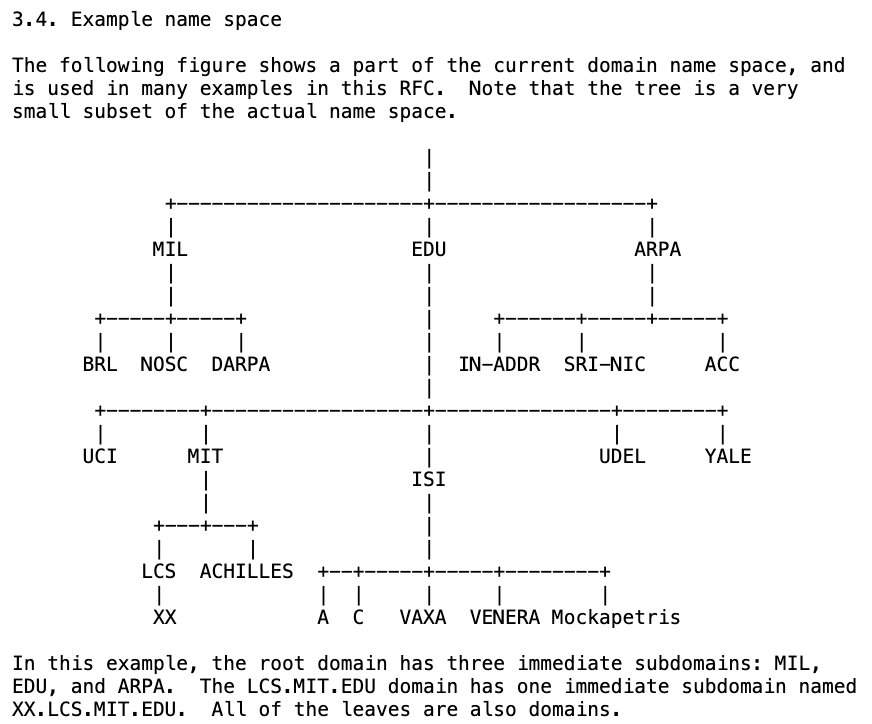
To solve growing scalability issues on the early internet, Paul Mockapetris introduces the Domain Name System (DNS) in RFC 882 and RFC 883, offering a hierarchical, distributed naming system to enable easier, faster and automated resolution of domain names to IP addresses.
The DNS simplified internet use providing a way to map human-readable domain names (for websites, email addresses and more) to computer-readable numbers (IP addresses).
IETF is founded
The Internet Engineering Task Force (IETF) is founded to formalize and coordinate the development and evolution of internet technologies. The first IETF chairman was Mike Corrigan.
The predecessor of the IETF was the Gateway Algorithms and Data Structures (GADS) Task Force, led by David L. Mills of the University of Delaware. In January 1986, the Internet Activities Board (now the Internet Architecture Board) divided GADS into two entities: the Internet Architecture (INARC) Task Force, chaired by Mills to pursue research, and the IETF to handle nearer-term engineering and technology matters.
DNS protocol suite adopted as internet standard
Two Requests for Comments documents, numbered RFC 1034 and RFC 1035, were published in 1987 by the informal Network Working Group, which soon after evolved into the Internet Engineering Task Force. Those RFCs, authored by computer scientist Paul V. Mockapetris, became the standards upon which DNS implementations have been built.
First RIPE meeting
Réseaux IP Européens (RIPE, French for European IP Networks) is formed by European service providers to ensure the necessary administrative and technical coordination for the operation of a pan-European IP Network.
The World Wide Web is born with the first website
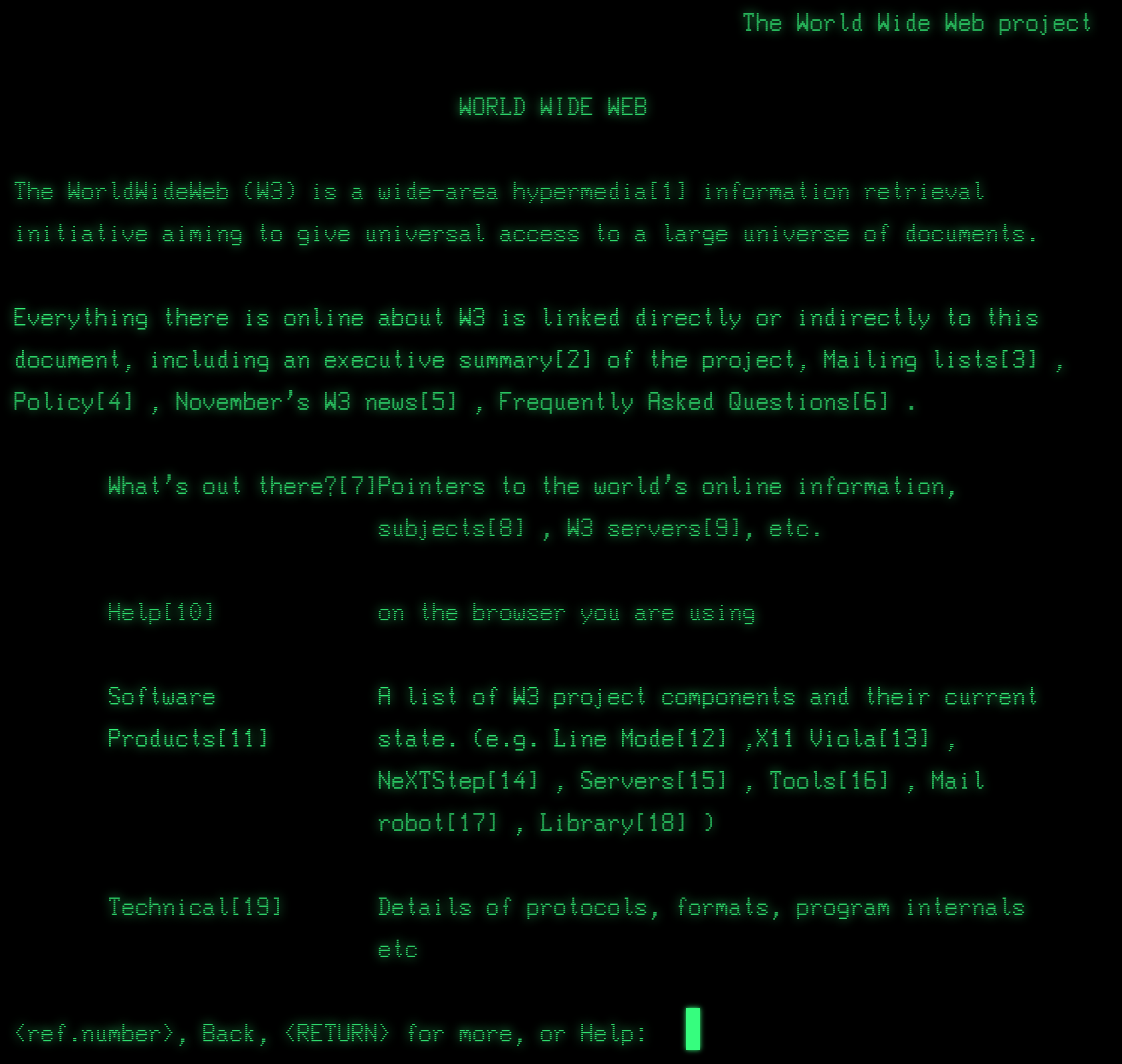
Tim Berners-Lee launches the first website at CERN, introducing the World Wide Web to the public. The site explained the web’s purpose, how to access documents via hyperlinks and how to create web pages, allowing users to access information via a graphical user interface (GUI) for the first time.
The URL is introduced
The Uniform Resource Locator (URL) is introduced by Tim Berners-Lee, defining web addresses for locating resources.
SSL and HTTPS introduced
Popular web browser, Netscape, is released with SSL version 2.0, using RSA encryption for secure communication between web browsers and servers across the DNS. This development includes HTTPS, laying the foundation for increased internet trust and secure e-commerce, in turn driving demand for domain names.
Verisign founded to support online trust
Verisign is established as a spin-off from RSA Data Security, focused on providing online trust using digital certificate services.
First commercial HTTPS certificates signed
Early SSL certificates for commercial websites, enabling encrypted communication over HTTPS, are issued by Verisign. Certificates, combined with security-capable browsers, helped establish a foundational trust model for domain-based e-commerce and communication using domain names as a verifiable digital identity.
Verisign acquires Network Solutions
Digital certificate provider Verisign acquires Network Solutions, the original domain name registrar and registry. The $21 billion stock transaction brings together domain name registration, DNS infrastructure management and digital certificate management, fueling growth of these key technologies and advancing scalability of the internet’s naming system.
Domain management standardization improves security and interoperability
The Internet Engineering Task Force (IETF) introduces the Extensible Provisioning Protocol (EPP), providing a standardized, XML-based framework for communication between domain registries and registrars. EPP simplified domain operations, including registration, renewal, and transfer, while enabling stronger authentication mechanisms to prevent domain hijacking. The protocol improved both operational efficiency and the security of domain transactions across the growing ecosystem of accredited registrars.
First major attack on DNS root servers
A distributed denial of service (DDoS) attack targets all 13 DNS root servers, the name servers responsible for answering queries for records in the root zone and the critical first step in the hierarchy of resolving human-readable domain names to IP addresses.
For approximately one hour, attackers used a botnet to send potentially overwhelming numbers of ICMP (Internet Control Message Protocol) ping packets to the root servers. Because the root servers were protected with packet filters configured to block incoming ICMP, the damage was not severe and there was little impact on the internet’s end users.
Deep space internet modeled on DNS principles
NASA successfully tests of the first interplanetary internet using the Disruption-Tolerant Networking (DTN) protocol, transmitting images to and from a science spacecraft ~20 million miles above Earth.
The experiment demonstrates the flexibility of internet architecture, including DNS-like identification for deep space communications.
Domain registration data strengthened with RDAP
ICANN implements the Registration Data Access Protocol (RDAP) as a modern replacement for WHOIS, driven in part by compliance with the EU’s General Data Protection Regulation (GDPR) privacy regulations.